
For as long as I can remember, I’ve been fascinated by strategy… but I came to love strategy by chance: a videogame.
Growing up, I wasn’t allowed to play videogames. My parents bought me the original Nintendo, but I played so much that my eyesight went bad. My father, furious that I needed to get glasses, banished videogames from the house. As if that stopped me, haha.
While I didn’t have a game console in the house, I had an old computer for typing school assignments. A friend secretly installed a game called Romance of the Three Kingdoms onto my computer, and because it was the only game I could play, I had no choice but to learn to like it.
I didn’t just like it, I loved it.
It was a turn-based strategy game that required you to manage cities, deploy generals, and try to unite all of China during the actual “three kingdoms” era, when regional warlords were all vying for territory and power after the fall of the Han Dynasty (around the year 184 CE).
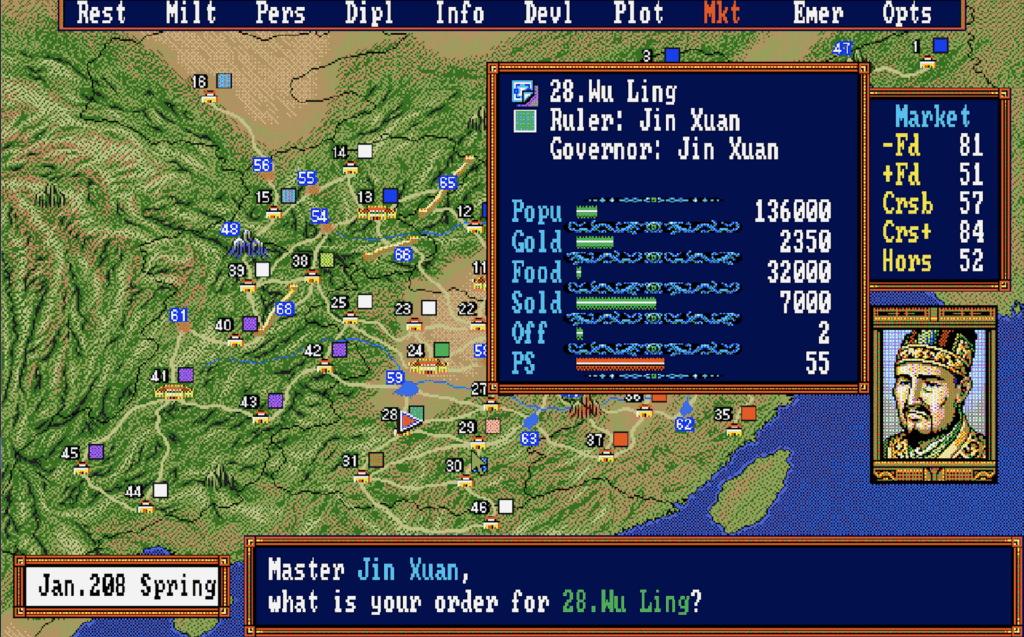
It was a struggle to make sense of all the characters and their Chinese names, but when I found out the game was based on a historical novel called Three Kingdoms, I couldn’t wait to read it.
The problem was that we didn’t have the internet or ready access to books like we do now, and I must have asked my dad fifty times to help me get a copy at Barnes & Noble, all to no avail.
When I saw that a public library several towns over had a copy, I requested an interlibrary loan. Then I told my dad we could just say I lost the books, pay the fine, and I could keep them for myself.
He laughed and said, “My son has a strategic mind.”
***
Three Kingdoms taught me that good guys don’t always win and that having the best generals or advisors doesn’t guarantee victory. It taught me, at a young age, that the world is very grey… but it also instilled in me the principles of loyalty, honor, strategy, and filial duty.
I also realized that success sometimes requires luck.
Take the famous Battle of Red Cliffs as an example. A famed advisor named Zhuge Liang (known as “Sleeping Dragon”) and his allies devised a ruse to convince the invading enemy force to chain their battleships together because their troops were better at infantry than naval warfare.
When the enemy navy started their invasion, their boats all chained together, Sleeping Dragon launched a massive fire attack, completely decimating their forces.

Great strategy, but the plan hinged on the wind blowing in the right direction at the right time. In the novel, Sleeping Dragon used magic to turn the winds in his favor. In reality, there was some luck involved.
If you’re interested in checking out more about Three Kingdoms, this set is my favorite for the books. You can also watch this explainer video from one of my favorite YouTube channels, Oversimplified.
I’m No Sleeping Dragon, But…
I’ve provided strategy for a lot of clients over the years: entrepreneurs, executives, small businesses, and large companies. But all those strategies really stemmed from things I did in my own business.
Since a good deal of my readership is interested in these insights, let me share my strategy for how I built my brand through the years.
***
First, if you’re pulling six figures or more, you’ve proven something important: you’re good at what you do, you can tell people about it, and you’re solving a real problem. That’s not nothing.
But this where a lot of people get stuck: what got them here won’t get them to the next level.
I know several people who, like the Battle of Red Cliffs, have done their share of preparation but also benefited from luck: a piece of content goes viral. Someone big in their industry gives them a shoutout. An unexpected boon comes their way.
They had a moment, maybe even a great year or two. But ‘getting lucky’ is not a plan. Going viral can mask how vulnerable you really are. There’s a difference between skyrocketing and sustainability. So, what do you really need to do?
I shared this framework with my mastermind in Chicago earlier this year and urged them to strongly consider which of these components they are going to put into their businesses.
You don’t need to do all of them but you do need some combination. I can’t break down which of these you exactly need for your situation here, but let me give you an overview:
The IP Empire Framework:
- IP – Your core frameworks and intellectual property (not borrowed from someone else’s certification)
- Book/Journal – Your best thinking, codified into something that can spread your views and ideas while you sleep
- Quiz/Assessment/Lead Magnet – Entry point that drives leads and qualifies prospects
- Content Marketing – Consistent, owned media that builds authority
- Cold Traffic – Paid advertising that brings new people in without you hustling for referrals. Also proves you have clear messaging—if complete strangers resonate with your offer, you’ve nailed it.
- Paid Community/Membership – Monthly recurring revenue and a community that grows with you
- Paid Gigs – Workshops, VIP days, speaking, 1:1 work
- Live Event – Galvanizes community and creates “material consequence” (which I wrote about in Issue #02)
You don’t need all eight of these layers but you should know your options. I’ve done all of these in my businesses, with an emphasis on some more than others in a given season. The point isn’t to do them all, it’s to find what you’re good at and what your market resonates with.
Now, let me take you through something I’ve never shared publicly before: my personal strategy to multiply the framework I just shared with you.
Stop Chasing Gigs, Start Building Properties
While I was building out my first lane of intellectual property which was capstoned by my first book, You Are the Brand, I quietly made an intentional decision to take the same IP and create inroads into new markets.
There were several reasons for this.
First, the principles could apply to different markets, especially anything service-based. The last five years have proven that. Plumbers, chiropractors, landscapers, professional speakers, dentists—heck, even ranchers—are leveraging personal branding to grow their footprint online.
Here’s something else: people talk about investing in actual property—real estate—as a way to grow wealth. I took that same concept to generate quicker returns with intellectual property, without having to raise capital to invest in real estate or wait for a piece of property to mature.
I might be thrilled to make $100,000 off a physical property I sell after holding onto it for a few years. But my intellectual property has allowed me to generate $100,000 and more, multiple times over, much faster—all without mortgages, tenants, and trips to Home Depot.
I started with markets where I already had relationships. Mary Valloni and I partnered to bring these concepts into the fundraising world. I co-wrote Own Your Brand, Own Your Career with Andy Storch for the corporate professional market. Right now, I’m working on a personal branding book with a partner in the real estate space.
Second, the personal branding market was (and still is) brutally competitive. There was no way for me to compete head-on with people like Amy Porterfield or Michael Hyatt. They had years of runway, established audiences, and massive platforms before I even got started. The smarter play was finding adjacent markets where the competition was thinner and the principles still applied.
Third, I hate having all my eggs in one basket. This leads me to an important part of my strategy over the years: antifragility.
Antifragility: The Ultimate Strategic Advantage
Nassim Taleb is a former Wall Street trader turned philosopher and bestselling author. His book Antifragile is a long, dense read but totally worth it. The simplification I’m giving here doesn’t do it justice. If you’re into strategy of any kind, you should read his book.
Taleb breaks down how systems respond to stress into three categories: fragile, robust, and antifragile.
- Fragile things break under stress. A wine glass. A business built on a single trending topic.
- Robust things withstand stress. They’re resilient. A diversified portfolio. A business with multiple revenue streams that all serve the same market.
- Antifragile things get stronger from stress. The immune system after exposure to pathogens. Muscles that grow from lifting weights.
Let’s take this into a business context. All of the markets I’m in have to do with marketing, branding, and helping people make money. When the economy tanks, my business grows. When things get scary and chaotic, people cut the things that don’t generate income and spend money on things that help them sustain, protect, or multiply their income.
During COVID, while most consultants were scrambling, my business went up. That’s not luck. That’s antifragility by design.
I don’t want chaos for people. But I’ve built my businesses this way intentionally. I’ve said it since my first book, You Are the Brand: People will pay if you help them gain time, money, or a skill, or save them time, money, or from having to learn a skill. That’s what survives.
A good example of the flip-side: the recent changes with Trump’s stance on DEI. Love him or hate him, let me look at this objectively as a strategist would.
Several of my friends have had incredibly successful runs in that space in recent years. I was really happy for them.
Then one administration essentially said DEI is no longer a priority. This had a swift trickledown effect across multiple markets: hiring, military, corporate training. Those same friends who had enjoyed some great years saw things slow down, some significantly. They were fragile because they had built on a single market that could shift with political winds.
Even if it wasn’t for a change in policy, an economic downturn also affects this market because people tend to cut non-revenue generating things during those times.
A strategy that trends towards antifragility would be to showcase your speaking when the market is ripe, but also build an IP around how you book engagements and deliver talks. Doing so makes you robust at minimum, antifragile at best.
Think long range, execute short range. From Three Kingdoms to your business, it’s the same game.
***
Later this fall, I’m thinking of hosting an accelerator for those to ideate, write, and market their book. As you can see, books are a big part of building an antifragile expertise-based business. If you’re interested:
Get on the Waiting List here »
If you’d like to connect on any other channels and content formats, my links are here: