
I used to think it was obligatory to write some post about gratitude every Thanksgiving. This year, I think I finally have something useful to say about it.
“Obligatory” is exactly how I’d historically describe my attitude towards gratitude.
When I was a teen, we’d sing this (lame) song called “Give Thanks” nearly every Sunday while putting money into the offering plate. Oddly, the publisher of that song probably made a killing off royalties.
I’m pretty sure this weekly practice conditioned me to believe that gratitude meant handing over money. Fine, but if I gave money with an attitude, I was still in the wrong.
There’s a verse that says, “God loves a cheerful giver.” If you want to find great examples of spiritual gaslighting, look no further than giving money and being told you had to be happy about it for it to count.
As life went on, gratitude became an afterthought—something I thought I should do, but never really understood or embodied. At best, I just imagined how much worse my life could be, i.e. “Kids in Africa are starving and you’re complaining about eating salad? You ungrateful brat!”
Ah, gratitude: another thing I suck at.
***
Back in 2016, I went through some pretty big upheavals in my life and was trying to get a grip. I figured journaling was a good thing to do but after awhile it became obvious that all my entries were basically full-blown complaining sessions about what was going wrong and how much things sucked.
It was bad enough for me to say to myself, “Geez, this guy is a whiny bitch… I’d never want to hang out with this loser.”
There’s a lot to that: not wanting to hang out with yourself. Spoiler alert: gratitude is what helped me heal that.
Because my journaling was so sucky, I looked for some journals online. Everywhere I looked, people like Tim Ferriss were raving about this little thing called The Five Minute Journal.
I went on Amazon and my first thought was, “What a crock! $28 for a journal with fill-in-the-blank pages? These guys must also make a killing!”
Anyways, I bit the bullet and figured all these people couldn’t be that wrong about it, so I cracked open my first copy. They absolutely pad the first 37 pages of the journal with research about the merits of gratitude (gotta justify that $28 price point) but…
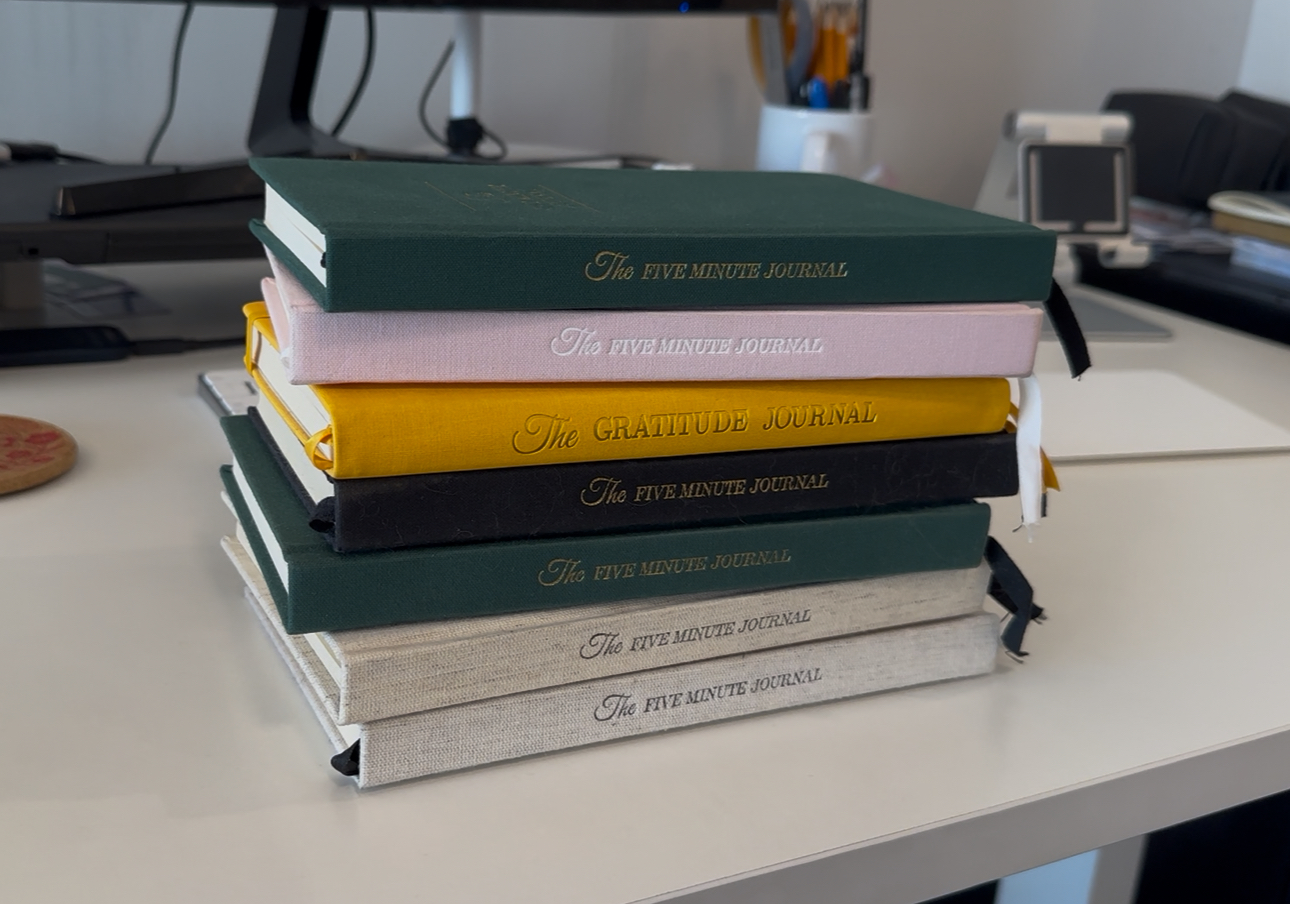 I’m now going on four years of writing in this journal nearly every day. This is not an exaggeration: I have stacks of these things piled up.
Each journal takes six months to complete. I’ve bought and handed out more copies of this to my friends than I can remember. (None of them do it of course, which is why they are unhappy, ungrateful bums.)
1. Exposure Therapy for Solitude
Despite being an introvert, I hate being alone with myself. I like being alone while doing other things—watching TV, playing video games, reading. But there’s a deeper point.
The journal forced me to pause first thing in the morning—I typically write in it immediately after my scream-inducing cold shower. I figured the pain of the shower automatically knock off one of the things I was grateful for that day: warmth.
But honestly, after a week or so, this practice forced me to be with myself and be intentional with my thoughts.
Like many of you, my life tends to run at high speeds: massive motion, achievement, reinvention. Nothing wrong with doing big things, but this is all forward growth.
Practicing gratitude created downward growth: deeper roots, like I mentioned in my last issue on wintering. I stopped sprinting past the good things that were happening in my life every day.
2. Bestseller? Not a Big Deal.
Another thing this practice did was flatten my emotional highs and lows. Translation: I became calmer.
If you’re in the same industry as me, or you’re a high achiever or an entrepreneur in some other lane, it’s likely you do things that most of the world probably thinks are pretty cool.
For those in my industry: you speak on stages. Maybe you write books. You write some emails and do a webinar and somehow make five or six-figures. You also probably do this with your proverbial hair on fire. You are the epitome of a dysregulated high-achiever.
I’ve written three books in my life and intend to write one more before I die. Each day that one of those books launched or hit a bestseller list, it was only one of three things that went well that day, according to my journal. Talk about squashing the highs, right? Sure, I’d celebrate, but it put things in context.
Over the last four years, the three things I was statistically the most grateful for at the end of each day:
- I worked out
- I didn’t drink the day before
- I did all three things that I wrote that would “make the day great” earlier that morning
It doesn’t take a genius to realize what I’ve been doing more of the past few years.
All my accomplishments and wins were great – but not everyone feels meaning in what looks meaningful to others. What really mattered to me was that I was starting to keep promises to myself. That was more important than anything else.
3. Practice Makes Grateful
When I was around four years old, my grandfather bought me a piano and my parents signed me up for lessons. I don’t remember much of them and have since forgotten how to read music, but apparently I was pretty good. My mom’s side of the family is very artistic and musical so I probably inherited some of their ability.
But dang, I hated practice.
I wanted the ability without putting in the effort. Years ago, I wanted to be a grateful person… without practicing gratitude.
After four years I don’t just practice gratitude, I’ve become a grateful person. I’d like to think that’s made me a better friend, son, brother, uncle, and yes – even mentor, coach, and writer to those who would have me in their orbit.
Typically we think it’s just to be grateful for what you have in the past. I love this tidbit from Matt Ridley in his bestselling book, The Rational Optimist. He’s a hilarious writer, so I’ll paraphrase some of what he says here:
“There are people today who think life was better in the past.
Imagine that it is 1800, somewhere in Western Europe or eastern North America. The family is gathering around the hearth in the simple timber-framed house. Father reads aloud from the Bible while mother prepares to dish out a stew of beef and onions. The baby boy is being comforted by one of his sisters and the eldest lad is pouring water from a pitcher into the earthenware mugs on the table. His elder sister is feeding the horse in the stable. Outside there is no noise of traffic, there are no drug dealers and neither dioxins nor radioactive fall-out have been found in the cow’s milk. All is tranquil; a bird sings outside the window.”
“Oh please! Though this is one of the better-off families in the village, father’s Scripture reading is interrupted by a bronchitic cough that presages the pneumonia that will kill him at 53 — not helped by the wood smoke of the fire. (He is lucky: life expectancy even in England was less than 40 in 1800.) The baby will die of the smallpox that is now causing him to cry; his sister will soon be the chattel of a drunken husband. The water the son is pouring tastes of the cows that drink from the brook. Toothache tortures the mother… The stew is grey and gristly yet meat is a rare change from gruel; there is no fruit or salad at this season.
“Nobody in the family has ever seen a play, painted a picture or heard a piano. School is a few years of dull Latin taught by a bigoted martinet at the vicarage. Father visited the city once, but the travel cost him a week’s wages and the others have never travelled more than fifteen miles from home. Each daughter owns two wool dresses, two linen shirts and one pair of shoes. Father’s jacket cost him a month’s wages but is now infested with lice. The children sleep two to a bed on straw mattresses on the floor. As for the bird outside the window, tomorrow it will be trapped and eaten by the boy.”
***
I literally laughed out loud when reading that. We tend to think life is just better in the past because we don’t know how to use gratitude to enjoy the present or empower us to a better future. There’s a lot to be grateful for.
I’m off to Virginia to see my family, eat some turkey, watch my nephews play with my dog, and make sure these creatures all bathe so they remain lice-free.
I hope this piece encourages you to build a gratitude practice. It doesn’t have to be The Five Minute Journal. I’m not an affiliate of theirs, but their overpriced little book has given so much more back to me than what I’ve paid.
Starting a gratitude practice and staying with it has absolutely been the single most important thing in my life in my adult life. I hope you’ll consider cultivating one. Thank you for reading today.