
Last week I covered three voices: what you say, what you write, and your presence.
But there’s a fourth voice that deserves its own attention: Your inner voice.
Some people have a very strong, supportive, warm inner voice. It’s amazing to meet them because for most of my life, mine has been a real piece of work.
That said, the inner voice isn’t always directly represented in what you say, write, or how you show up:
- Brilliant people can have low self-esteem.
- Talented people can struggle to see their own value.
- Loved people can feel unloved.
The proposed remedies include positive thinking, affirmations, mindset, stepping into your higher self (whatever that means), or doing 75 Hard.
Ok sure, but those all feel like “white knuckle” energy. I’ve done my fair share but in recent years, my experience has been the opposite:
Stop clenching, start noticing.
#1. Track to Mirror, Not to Change
Simple things that lower the noise around my inner voice:
- No social apps on my phone.
- Deleting AI on the weekends.
- Paying for YouTube that blocks ads.
My career requires being online so I have to be even more wary of “Garbage in, garbage out.”
If you’re brave enough to delete a social app even for a day, notice how often you habitually reach for your phone to click on it. (Yep, you’re a junkie.)
Beyond elimination, the real gamechanger for me was tracking behaviors that were adding to the noise. Tracking is an easier start than white-knuckling your way forward.
Since I write in The Five Minute Journal (almost) daily, I started to write DND (for “Did Not Drink”) on days I didn’t have a glass. I wasn’t even trying to cut down at the time, I was just curious about my patterns.
After a month I noticed some entries would say, “Slept really well, feel really good.”
Blinding flash of the obvious: it was because of the DND the day before.
Resolutions, goals, sweat checks… sure. What we mostly need is a mirror.
#2. Bento Box Your Brain: Ideas vs. Notes
David Allen famously said, “Your mind is for having ideas, not holding them.”
The world is my dumping ground: envelopes, napkins, Apple Notes, voice memos, a million screenshots, whiteboards everywhere – including the hallway, bathroom, and on the fridge.
I sort all that stuff into two categories: Ideas and Notes.
- Ideas are self-generated: Original thoughts, reflections, journaling, frameworks, that inner voice fellow.
- Notes are things absorbed from books, podcasts, conversations, masterminds, keynotes — anything external.
Sorting isn’t dead time or waste because looking back over your own ideas and notes reveals patterns.
For eBooks: I use an app called Readwise. It pulls the highlights from your Kindle or other e-readers.
For physical books: I turn on my iPhone voice recorder and read every passage I’ve underlined or highlighted out loud. For a normal business-sized book, this takes about 20 minutes. The slow, deliberate chewing is the point.
Then I have AI clean up the transcript and sort into bullet points. That leads me to:
#3. One File to Rule Them All: My “Clarus” Document
All that stuff goes into a single Google Doc I call “Clarus” — a play on the word “clarity.” (I’m in a name-things-in-Latin phase right now.)
The Clarus Doc has grown over time but it’s made of simple tabs:
- Ideas
- Notes (each book gets its own tab)
- Transcripts from calls with coaches and masterminds (you don’t spend thousands on this never to review your calls again… do you?)
- Content musings
- Existential thoughts
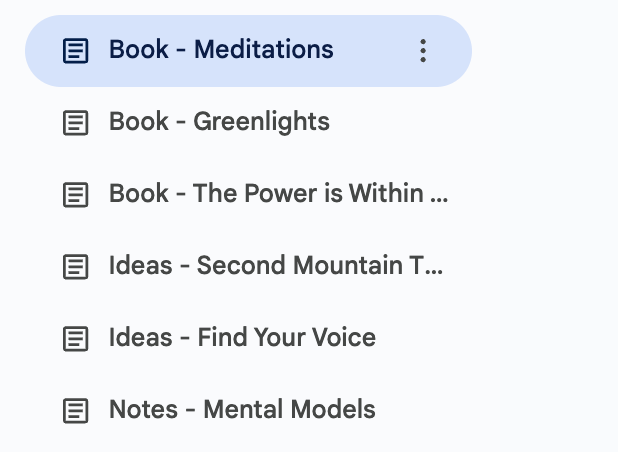
I even load results from personality tests in there: Enneagram, DISC, MBTI, Human Design, Fascinate… I even had “What Kind of Game of Thrones Character Are You?” results for awhile.
(If you’ve taken my Idea to IP Assessment, you could put those results into your own version of a Clarus doc.)
Some have aversions to tests and assessments. Personally, I’m cool with anything that sheds even a bit more light on myself. I trust my judgment to chew the meat and spit out the bones.
I’m sure there are better setups but this works for me because I’m in Google Docs all the time.
I also prefer this because you can sync a Google Doc to a Claude or ChatGPT project, making retrieval and engagement with it easy.
Just use what works. The simpler your tools, the more likely you’ll use them.
People Fear AI Because They’ve Just Been Copies of Copies
My friend and successful realtor, Alex Yu, shares a great analogy: When keys are kept in lockboxes for realtors to show homes, the keys sometimes don’t work.
It’s because the keys have been copied so many times that the little grooves that make each one distinct have worn down. The key technically fits but it can’t open the door anymore.
Many of us have done the same thing. We’ve outsourced our inner voice for years – to our parents, culture, social media, church, the news, what someone says about us.
It’s time for us to be more than a composite of what we’ve absorbed or consumed. To be more than parrots. Trust me, you have it in you.
A few questions to let your inner voice and wisdom speak:
- What is a big lesson you’ve learned from firsthand experience in the past three years?
- What is a big lesson you’ve learned from firsthand observation in the past three years?
- What is one thing you’ve changed your mind about that you never thought you would?
- What surprised you most about your 30s / 40s / 50s (or name any decade or phase of life)?
I push my clients and students hard to share that kind of stuff. It’s interesting. It’s real. It’s earned. It’s you.
The move isn’t to power through and force the inner voice to speak louder. It’s to unclench. Open your fists. Open your heart.
***
Vox Clara is a Latin term meaning “a clear, resonant, and distinct voice.” This is the second installment in a series exploring four voices and how to develop them.
If this resonated, I’d be grateful if you forwarded it to someone who might need to hear it, or invited them to subscribe at mikekim.com/newsletter.
Two Resources for You as Next Steps:
1. Take the Idea to IP Assessment.

This 10-minute assessment shows you exactly where your business sits across 8 categories, then gives you a personalized roadmap with your biggest gaps and highest-leverage next steps.
Several hundred people have taken this already and I’ve had over 25 1-on-1 conversations with them about their results, to great fanfare. It’s free until the end of the month. After that, it’s gone.
Take the Idea to IP Assessment »
2. Own Your Brand, Own Your Career: Now available on audiobook.

In this book I co-authored with Andy Storch, we show working professionals how to leverage the principles of personal branding.
Packed with real-world examples, step-by-step frameworks, and actionable exercises, our goal is to help you to take control of your professional reputation and future.