
The most unhelpful thing an established expert can do right now is to keep publishing unaimed content.
I mentioned last issue that I’ve been doing a lot of 1:1 with clients. Today I want to show you how I’ve been walking them back to center. In almost every case, it’s meant creating less content, not more.
Less but better, and less but aimed.
“1,000 True Fans” Was Right. We Did the Opposite.
Much of my philosophy over the years was shaped by a 2008 article by Kevin Kelly called “1,000 True Fans.”
At the time, Kelly’s claim was prophetic. In 2016 it sounded heretical because everyone was chasing vanity metrics by that point. Here in 2026, Kelly’s take has aged like fine wine.
Funny how much of life comes full circle. (Can’t we just bundle all these streaming subscriptions into one platform and call it… cable TV?)
The industry of ideas has come around the same way. I remember when people had a goal of reaching 10,000 followers on Instagram so they could post links in a swipe up feature on IG Stories. Now you can just post a link.
Then it was 100,000 followers, so you’d have a better chance at getting a blue check mark. (Elon Musk did away with that when he bought Twitter.)
Then a million followers on any platform, because for whatever reason, one million of anything just sounds… impressive.
One more 2008 nugget. In their book Pain Killer Marketing, Chris Stiehl and Henry Devries showed that 12 to 15 one-on-one conversations surface about 80% of the pain points in a market.
Not 1200 to 1500. 12 to 15.
You don’t need a bigger audience to figure out where to aim your content. You need to listen to a small slice of the one you already have.
The One Framework
Here’s another simple Venn diagram. (You can tell I love them.)
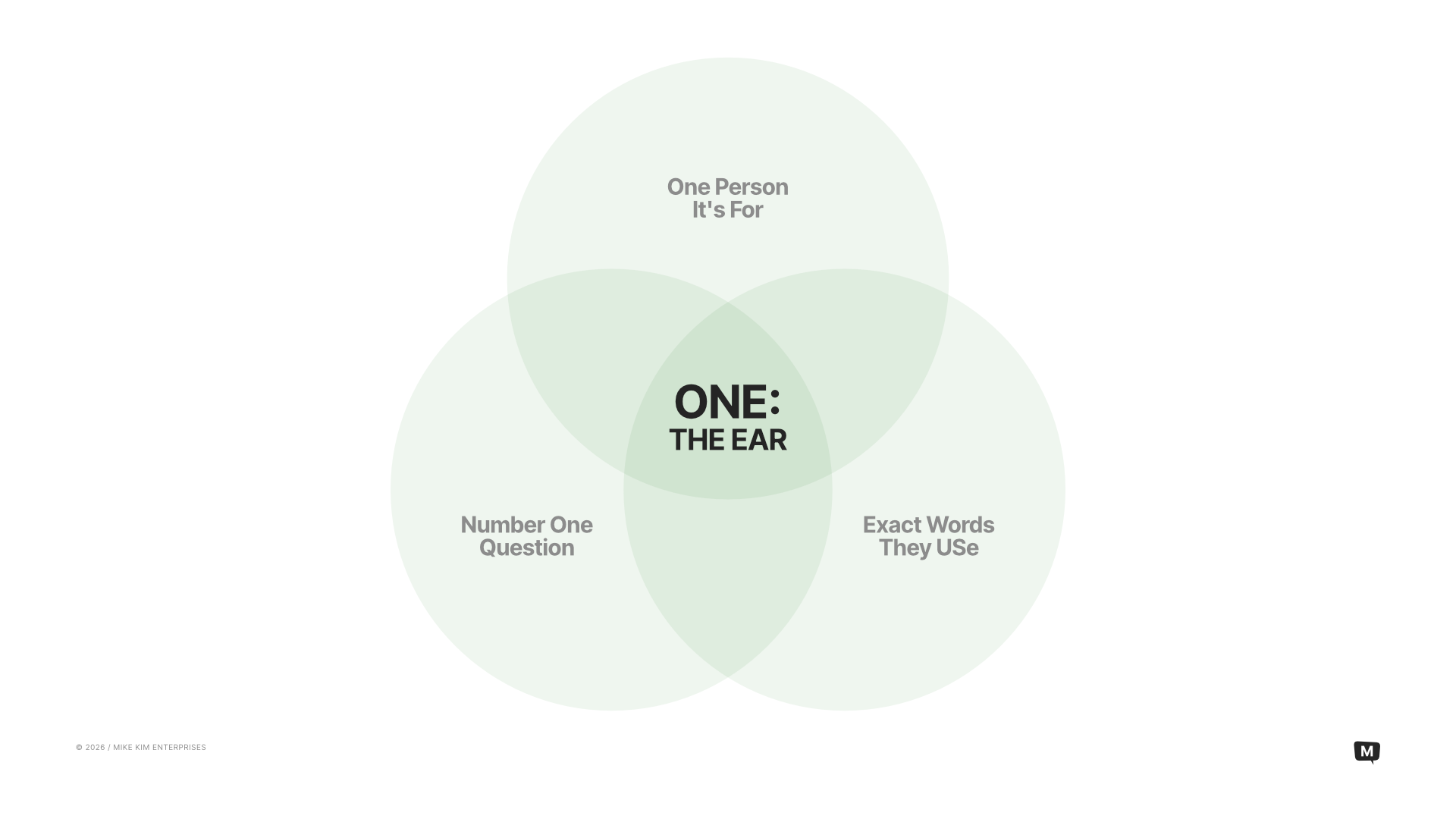
I call it the ONE framework, which simply refers to:
- One person you’re writing to.
- Number one struggle they’re facing.
- Exact words they use to describe their situation / struggle / challenge.
(Next week I’ll show you how this fits into the larger messaging matrix I now use with every client.)
I admit that over the years, I haven’t been that great at listening to my audience. What saved me is that I always knew who I was speaking to because I had so many lead magnets, webinars, and wrote some books. To do those things well, you need to pre-validate and prototype.
As I’ve been going through some shifts the past year, I took the time to go through this a few months ago.
I sent out a three-question survey with one optional checkbox at the end. The response, relative to my total numbers, wasn’t huge. But remember Pain Killer Marketing: a handful is enough.
I’ll share my actual questions below. You should reconfigure them for your use. I’ve put a short explainer under each.
1. Which of these best describes you right now?
- Coach, consultant, or advisor building (or rebuilding) a personal brand
- Corporate professional exploring a move toward something of your own
- Entrepreneur or business owner trying to grow through thought leadership
- Creative, author, or speaker figuring out the business side
- Just a person navigating this life, trying to find meaning and joy along the way
- Other:
Objective: To simply get a better understanding of who is on your list.
2. When you think about this season of your life: your work, your craft, what’s next, what it all means… what’s the #1 thing you’re wrestling with right now? (Be as specific and unfiltered as you want. The more detail, the more helpful.)
Objective: Allow your readers to tell you what they’re bumping up against.
3. How do you consume / prefer consuming this newsletter?
- I read the email
- I read it using the blog link for your site
- I listen on the podcast
- I watch on YouTube
- Some combination of the above
Objective: This is just a platform question to help me understand where to focus my energy the most.
4. Optional checkbox: Would you be open to a short, no-pitch conversation?
Objective: There’s no substitute for talking to people. I’ve done about 20 of these calls and plan to do more. (If you responded to my survey, hang tight – more spots coming!)
To be fair, I’m no survey expert like Ryan Levesque: I recommend his book, Ask.
But even a survey this simple, which I sent as a plain Google Doc, can hand you incredible insight.
***
One other reframe: You’re asking people to take time out of a busy day, and they’re saying yes.
Even if they don’t look like your ideal market on paper, these are the ones who showed up. At some point you might want to stop chasing the person who keeps ghosting you and go out with the one who’s actually paying attention.
Or, change the frequency of your broadcast. It’s easy to have a picture of your ideal client in your head. The reality may say something much different.
As Tom Peters said decades ago, “You are your clients.”
Another simple exercise. When I started out as a direct-response copywriter, I did a version of this constantly on Amazon.
Search for books on any topic you want relative to your market and rank them by number of reviews so you are looking at the top ones. Then read the longest five-star reviews and the longest one-star reviews. That will give you both sides of the story.
Amazon is literally a free focus group.
Many experts I know have never even done a simple reader survey or used this Amazon strategy. That’s how you drift towards creating unaimed content.
Next week, the full messaging matrix.
Til next time,
Mike Kim
Tuesday, June 16, 2026
Written with a Blackwing pencil, edited on a MacBook pro, published on my WordPress site, and emailed via Brand You Funnels (my whitelabeled Go High Level service). Graphics by Jason Clement.
Know anyone who would enjoy my writing? Send this link »
Connect: LinkedIn • Instagram • YouTube