
As I shared way back in [#5] The Economy of Meaning, we moved on from the Knowledge Economy and are currently in the Attention Economy.
People pay first with their attention. For us experts, this is an expensive acquisition. The fraction of those who keep paying attention will stay not because of what you know, but for how you think.
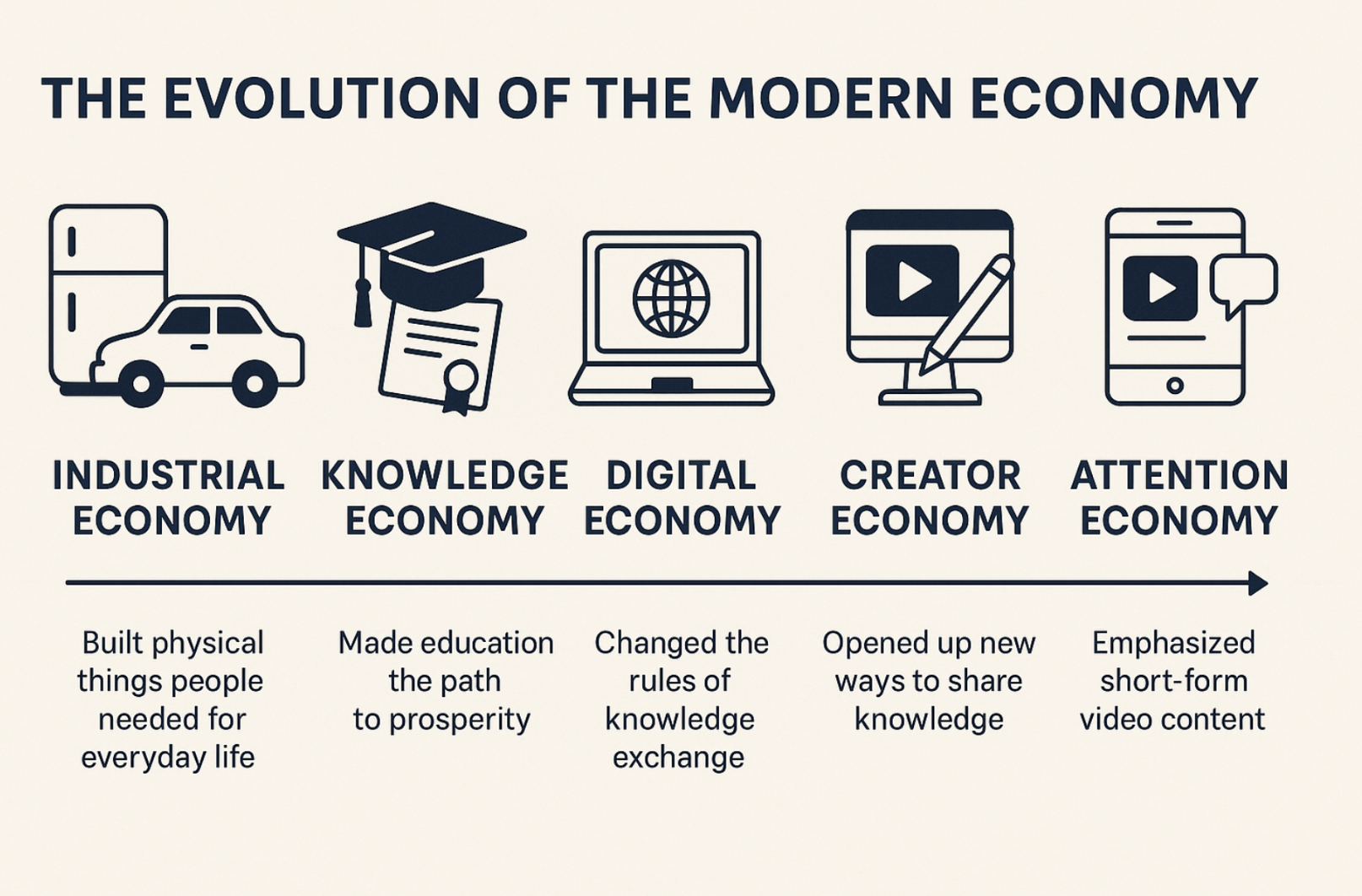
Ultimately, I believe this will lead us to what I call The Economy of Meaning.
Meaning isn’t one thing. It’s relationships, work, health, wealth, presence, legacy, gratitude… all feeding into each other. It’s an ecosystem where meaning is built from many disparate but interconnected parts.
If your work helps someone discover meaning, you’ll be in good shape.
Lest you think I want you to pivot to becoming some sap who only talks about feelings, here’s a concrete example.
- First, your vehicle needs to shift to what humans find meaningful: experiences, connection, events, etc. For some of you this is easy: do more workshops and retreats. Bring ‘em back.
- Second, that doesn’t mean your “thing” needs to be on a meaningful topic: you could host a Lego workshop. But the connection that happens around that activity is what gives it meaning. Be intentional about letting that happen.
This is a window of opportunity to evolve and refine your message. It’s also a necessity.
Years ago, I wrote You Are the Brand, which still sells about as well as the month it launched.
One of the frameworks, The Personal Brand 3, has been cited as the most helpful (I’ll share it below).
But the PB3 was only ever one piece of the picture. It uncovers the heart of a message, the why underneath everything. For a pre-AI world, heart was usually enough to set you apart.
A message for today needs three things at once: heart, voice, and ear.
The heart is why you say it. The voice is the register you say it in, the ear is who you say it to.
I’ve shared pieces of this matrix before. Here’s the whole thing in one place. At the end, I’ll show you what happens if you miss any of the three (not good, so stick around).
PB3: The Heart
I first introduced this in You Are the Brand. It has found its way into every messaging title I’ve written since.
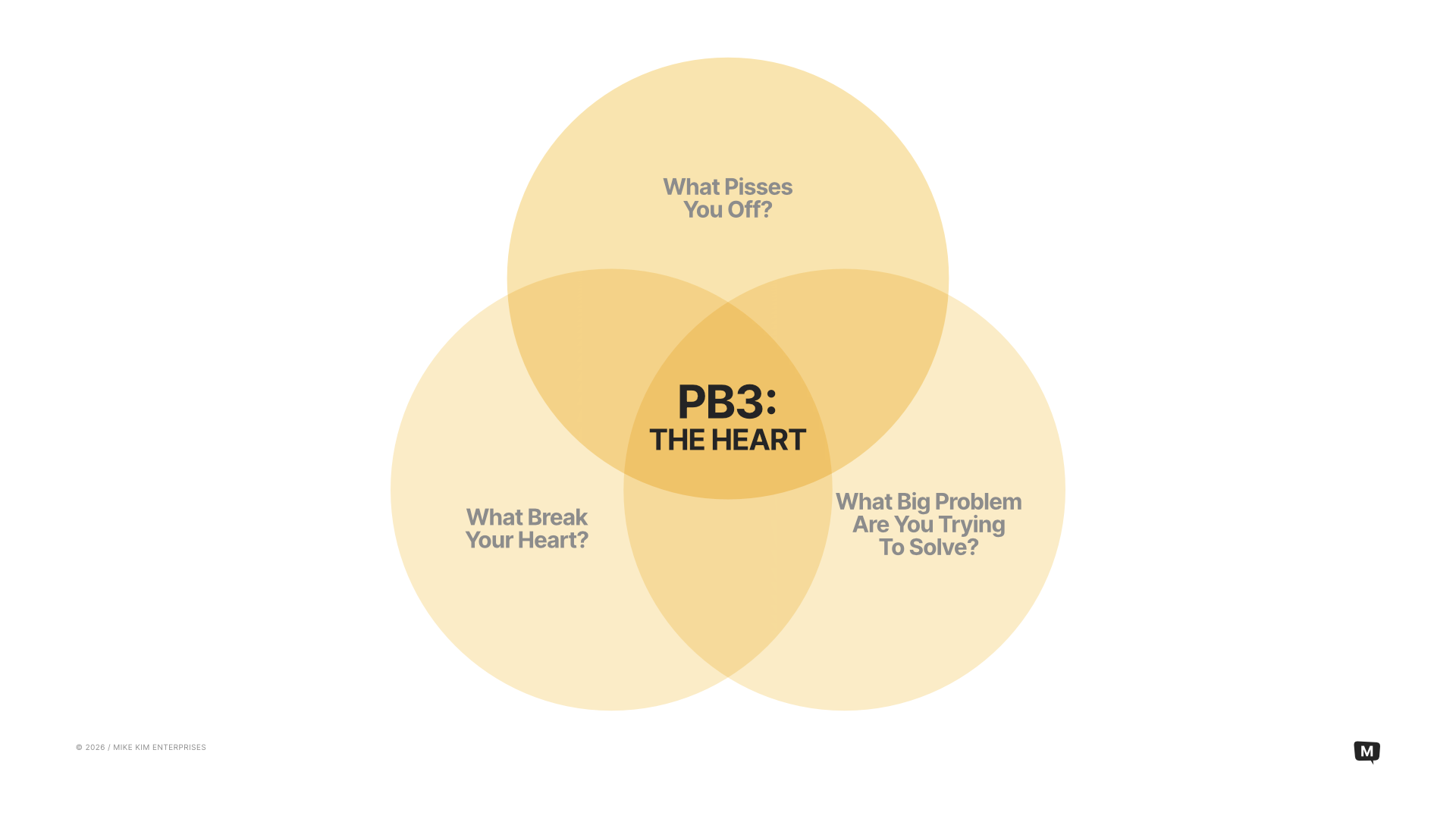 1. What pisses you off? This is an injustice you see for a person, a cause, an issue.
This evolves over time. When I created this exercise and went through it, what fired me up was personal. It pissed me off that my hours and income were controlled by someone else. I was driven by a present negative pointing at a future positive. That was honest, and it was enough to get me moving.
As time passed, my answers evolved. In my marketing heyday, I hated the culture of selling shortcuts and marketing-bro tactics. I worked hard to be a positive alternative. I didn’t make as much money as those guys, but I could sleep at night.
More recently, what pissed me off became harder to name. I got closer to it by paying attention to how I think.
What actually gets me now: “the game” rewards you for not being yourself. We have to play all these stupid, grandstanding games.
I like playing games… as entertainment. I’ve always hated games elsewhere: relationships, business, politics of every kind. Squid Game is fine to watch as a TV show. Terrible way to live.
The anger is data. It points straight at what I’m here to fix.
2. What breaks your heart? That’s compassion.
Different from what makes you mad, this is what makes you ache for the person on the other end.
What breaks mine today is something along the lines of people who have to perform under a prison of their own making. They’ve built a business or brand they no longer want to work for. They feel trapped.
Some have allowed the official version of themselves to suffocate the real one. Others never had the means to get it out at all. The self stays trapped and over time you start to believe it was never worth much anyway.
On a practical level, we take the ability to speak and write for granted. If you’ve ever broken your dominant hand, caught a bad run of laryngitis, or even sprained a finger and tried to type, you know the strange powerlessness of it.
Now imagine that on a grander scale, until it becomes the condition of your life.
So heartbreaking.
Anger tells you what you’re against. Compassion tells you who you’re for.
3. What is the big problem you’re trying to solve? That’s purpose.
Looking back, the throughline of my life is helping people find their voice, own their power, and speak their life into the world. I help people speak for themselves, from themselves.
Everything else I do is a version of that.
- Business is nothing more than solving a problem for a profit.
- Some problems are not profitable to solve, hence nonprofits.
I do both. But this goes beyond just problem solving. We have to get down to the underlying purpose of our work.
For me, I’m genuinely happy to help you hit your number so you can buy the Ferrari and oceanfront condo. Truly.
But if I’m going to use my talents on first-world problems, I’m gonna use them on third-world ones, too. Not just charity or handouts: real change.
Right now I’m helping a shelter in Romania for kids from war-torn Ukraine. They raised six-figures a few weeks ago and are fully funded for three years. No business win can compare with that.
The simple question driving me now: “How and where can I be of more value overall to the world?”
POP: The Voice
What you say is content. Your voice is the register you say it in.
Voice gives your content character, tone, and color. Take two great vocalists: one will often fit the song (content) better than the other. Sinatra’s My Way is better than Elvis and it’s not even close. I will die on this hill.
Your voice gets its “pop” from three things: Personal Experience, Opinions, and Predictions.

- Personal Experience. The lessons and scars only you have lived, which often reveal how you developed your taste, your wisdom.
- Opinions. What you actually think, not the committee-approved version. Conviction is the signal of experience now, not intelligence. Say the thing already.
- Predictions. A real call on where things are headed, on the record, before consensus is reached. Remember: no stakes, no ratings.
Strip all three out and you’re left with white rice messaging: Filler that nobody remembers. Instead of You Are the Brand, you are now You Are the Bland.
I introduced POP in [#34] AI Slop is The Best Thing That Ever Happened to Genuine Experts.
ONE: The Ear
ONE is short for one person, their number-one question, and the exact words they use. Do this, and you’ll have their ear.
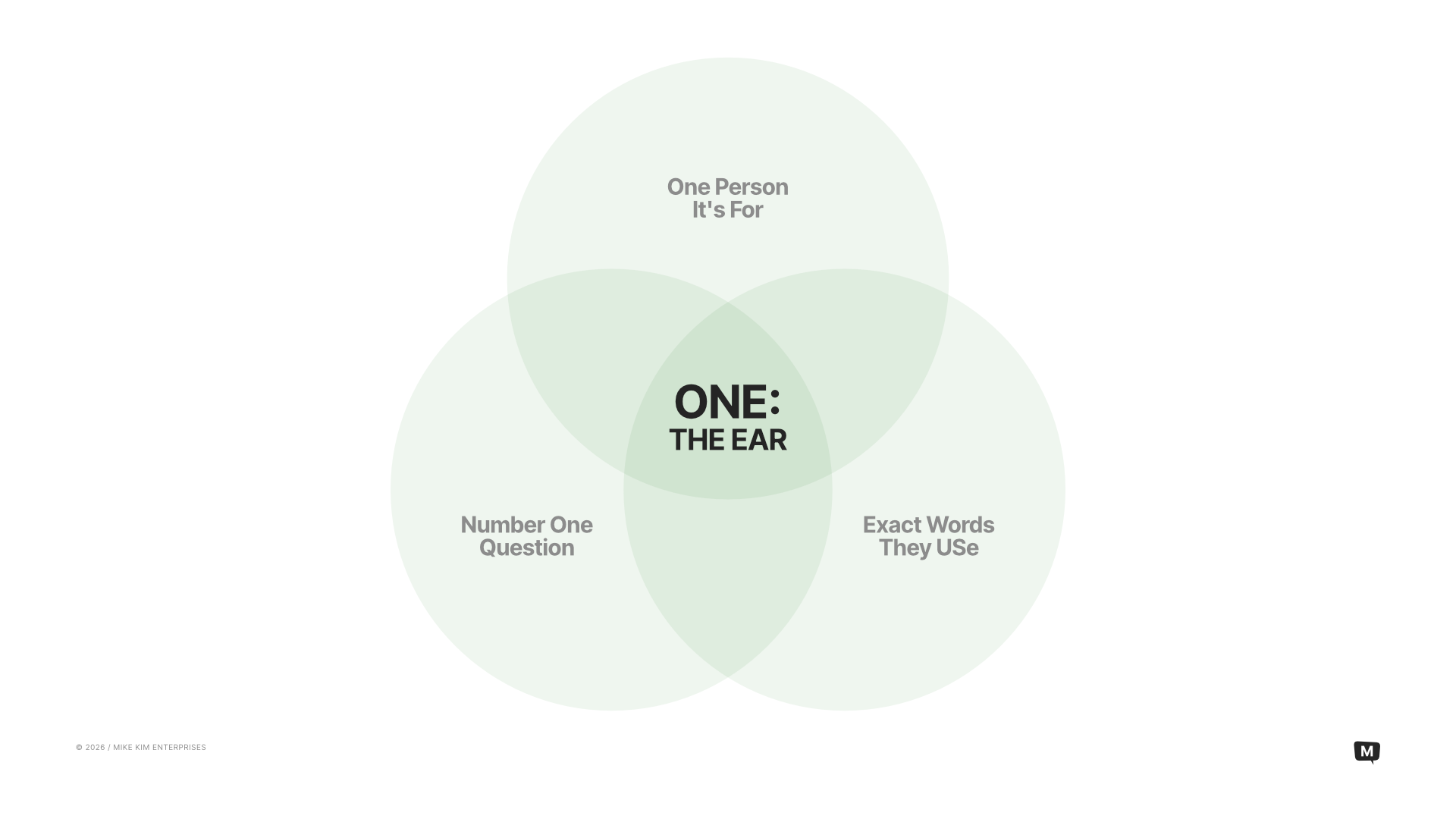
- One person. Name a real, specific human. If the person you’re trying to attract is different from the one who keeps showing up, you may have a signal problem. As Tom Peters said decades ago, “You are your clients.” That is the ultimate litmus test.
- Number-one question. The single biggest thing they’re wrestling with right now. I sent my list a plain three-question survey a few months back, and the answers reset my entire content plan.
- Exact words. Hand people their own words back and they feel understood. You don’t need a big audience to find them, either. Twelve to fifteen real conversations surface most of the pain in a market, and the longest five-star and one-star reviews on Amazon are a free focus group.
(I introduced ONE in [#38] The Unaimed Expert: Established, Consistent, and All Over the Place.)
***
The Full Messaging Matrix
When you put it all together, you stop just teaching what you know. You start sharing who you are (heart), out loud (voice), to someone specific (ear).
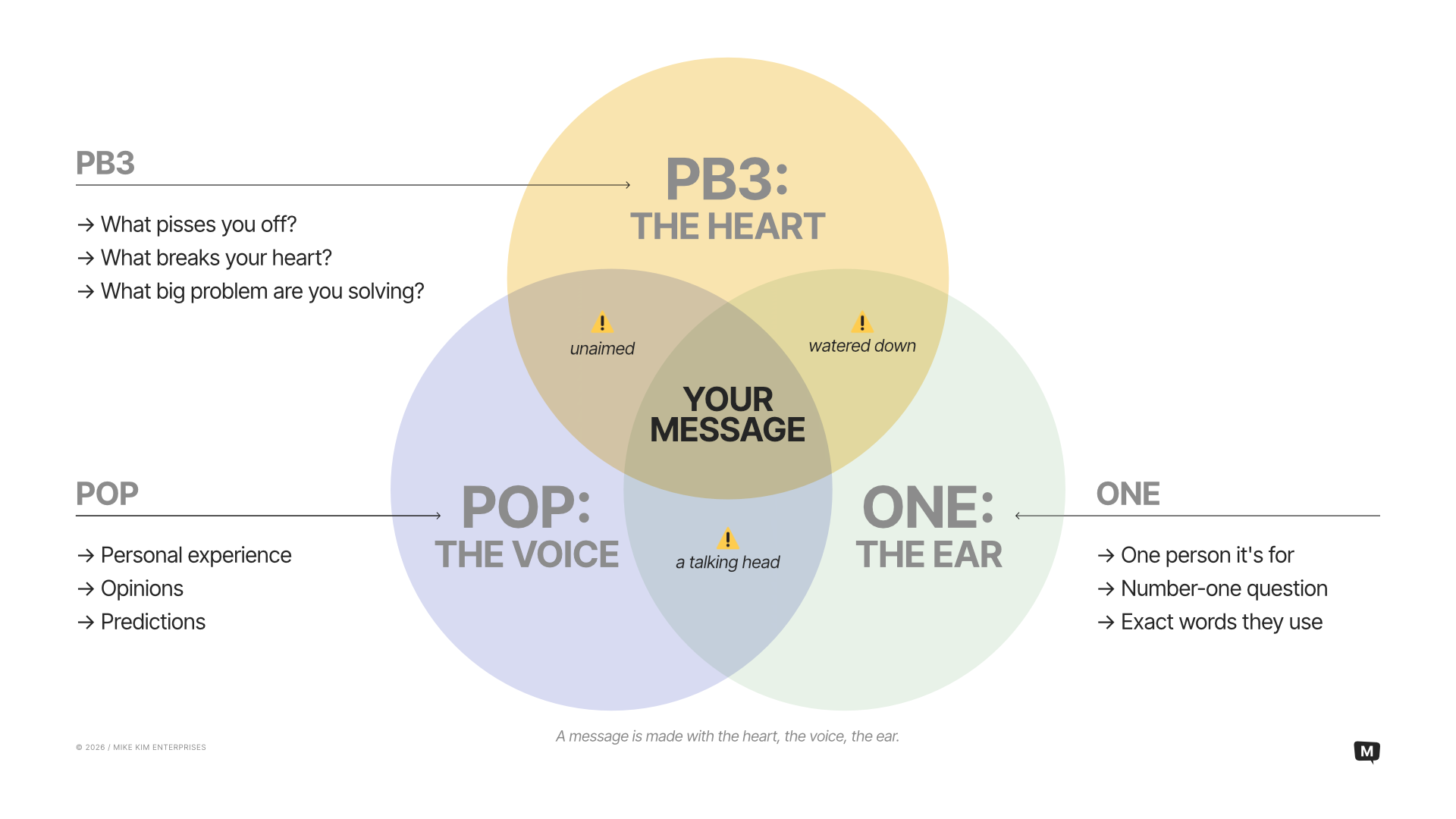
If you miss any of these, you end up with these gaps:
Heart and voice, no ear = UNAIMED. You care, you’ve got takes, but you’re broadcasting to no one in particular. That’s unaimed. Passionate content nobody asked for.
Heart and ear, no voice = WATERED DOWN. You care, you know exactly who needs this, and you still round off every opinion until it’s safe. That’s watered down. White rice messaging.
Voice and ear, no heart = TALKING HEAD. Personal experience, sharp opinions, predictions, all aimed at exactly the right person, and nothing substantial underneath. That’s a talking head. Might as well go ramble on CNN or Fox News.
Notice the last one is different. “Unaimed” and “watered down” describe your message. Talking head describes you as a messenger.
Not sure about you, but I don’t fully trust anyone without a few scars on the soul.
I’m happy to learn from smart people, but that’s where it stays if I don’t think they have any substance.
When you finally get what’s inside you out, in your own voice, to the person it’s for, you become someone you weren’t before. The person you become on the other side of that never un-becomes it.
This was a long piece, so I recommend bookmarking it from my site here:
I hope this helps you. I’ve given you my best… free.
Now, I’m taking some time off the next few weeks to visit parts unknown (people think I’m going to a certain country, I lied) … so take some time to chew on this one.
Bon voyage,
Mike Kim
Tuesday, June 23, 2026
Written with a Blackwing pencil, edited on a MacBook pro, published on my WordPress site, and emailed via Brand You Funnels (my whitelabeled Go High Level service). Graphics by Jason Clement.
Know anyone who would enjoy my writing? Send this link »
Connect: LinkedIn • Instagram • YouTube