
Recently, I got a text from someone in my mastermind:
“I’ve only written so little of my book and already feel like it’s changed the way I think and write in my newsletter—I notice different things and where parts can be improved. That really hit me today. 🤯”
I smiled at the message, not because I was surprised but because it’s the exact pattern that plays out in nearly every person I’ve seen write a book.
They all think they’re writing a book about their expertise. Turns out, the book is re-writing them.
Here’s what most people talk about when they pitch you on writing a book: Authority! Credibility! Speaking gigs! Higher fees! Lead generation! A “calling card” that opens doors!
All true, but that’s like talking about marriage only in terms of tax benefits. Obviously, there can be financial benefits if you write a good book (key word: good). Since most people think about this first…
Here’s an Inside Look at My Book Numbers
I released my first book, You Are the Brand, in July 2021. At the time, I had 14,465 email subscribers. Two guiding principles that I follow:
First, you should generally aim to make $1 per email subscriber in monthly recurring revenue. This is a sign of overall health regarding your email list, offers, and marketing. Obviously not every person is going to pay you $1… the idea is that your offers should total to that amount.
Second, expect just 1 to 10% of your email list to buy your book the week it releases. Why? Once books are out, they’re out. There’s very little scarcity you can build in to a book launch, which is why you often see authors offer bonuses if you pre-order the book. All orders made before the book comes out count towards sales made in the first week. Since most sales will likely happen that week, it gives the book a better chance to hit a bestseller list that week.
With my numbers, there was no way to hit the Wall St. Journal or USA Today bestseller list. At the time, I was told I needed to sell about 6,000 copies in launch week to hit it.
That’s where my friends with email lists came into play. I stewarded good relationships with colleagues through the years, so I called in favors. They all came through for me: promoting my book to their email lists, interviewing me on their podcasts, and even endorsing my book. If you plan to release a book, it would be in your best interests to:
- Grow your email list
- Create launch bonuses to spike pre-orders
- Make friends with people who have good lists
Two out of those three take time and foresight. You’re smart enough to figure out which two. Get crackin’.
***
Now let’s look at post-launch numbers. None of this would have happened without the momentum and excitement around my book:
- $100,000 from certifying people in the methods of my book.
- $150,000 from a coaching program two months after my book released.
- Six months later, I had 33,268 email subscribers – up from 14,465.
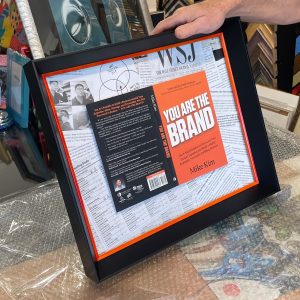
- I hit the Wall St. Journal and USA Today bestseller lists: #4 on WSJ (I was outsold by three new books that came out about Trump that week) and #63 on USA Today. These are credentials no one will ever be able to take away from me.
As of this writing, You Are the Brand has 415 Amazon reviews and 253 ratings on GoodReads. The book is still outperforming the industry average (it’s said that about 1% of readers leave reviews) which I interpret as, “I wrote a good book and earned engagement from readers, so much so that they’re willing to write unsolicited, honest reviews.”
This is now the third time I’ve used the phrase “good book” – let’s unpack that.
One of the best pieces of advice I got was from Jeff Goins, who simply told me: write a good book. While he’s a friend, I hired him (there’s a lesson there) to give my manuscript a look. On one of our calls, he said something like:
“Right now, your book is a B. That will be good enough for everyone around you. Your publisher will urge you to print it. Your friends and family will be proud of you. Your audience will probably like it. You’ll maybe hit a bestseller list… but it’s a B.
If you put in the extra 5% to make it an A- then you’ll have two launches: the first one when it launches, and another wave a few months later when people have actually finished reading it and share it with others.”
Jeff is the kind of guy you want critiquing your stuff. He’s contrarian, snobby with his preferences in art, music, and writing (in the best possible way), and doesn’t sugarcoat things. He’s also sold a lot of books. After we got off the phone, I moseyed on down to a Key West dive bar and ordered a stiff drink.
I probably cursed him off a bit in my head because I knew he was right. Jeff knew how to talk to me… I’m the kind of guy that prefers to get chewed out by a coach who tells the truth rather than be flattered and get a participation medal. (I blame my freshman year basketball coach.)
I got enough B’s in high school, so I decided to do my best to make it an A-.
- I renamed chapters to make them more enticing
- Changed the title several times
- Took creative control of the artwork
These days I rarely push the book. Marketing it is typically more passive, like soft mentions here in my newsletter or shownotes for YouTube videos or my podcast… but the book still sells and gets reviews.
You may see all this and think, “Easy for you, Mike… you were already somewhat known in your industry when your book came out.”
Fair, but why was I somewhat known in my industry in the first place? Because I grew an email list. Through that list I created content that others connected with, which made it easier for me to get noticed by other experts in my industry, who then helped me promote my book.
Everyone wants the benefits of online marketing. Very few are willing to do online marketing.
***
Not every book has to be some epic bestseller. Last fall, I co-wrote a book in a completely different niche and my partner and I self-published it. The TAM (Total Addressable Market) wasn’t large enough to warrant going through a publisher or trying to hit a bestseller list, other than Amazon (which we did).
I won’t share specific numbers since it’s co-owned IP, but we’ve built a membership of several hundred monthly members and it keeps trending upward. This is in a category that probably shouldn’t be doing this well. Many people I know would be thrilled to have a membership that size… the credit goes to the book and a YouTube channel based on the book.
A good book enables your intellectual property that compounds. It clarifies your thinking so sharply that everything else you build becomes more valuable.
Writing a good book will never be bad for your business.
A few more thoughts on what it takes to write a good book, and why it can reap so many benefits outside of just money. (Keep in mind, I’m not advocating for anything I haven’t done here myself.)
Earn the Right to Speak into the Lives of Others
The way to do this is by stress-testing your ideas with real people. This is what I try to inspire in the people who’ve hired me to be on them about getting their books done. Sometimes I have to drag them by the collar, but that’s my job 🙂
You, as the author, are going to feel a hundred times more confident getting feedback from a real person versus freakin’ AI or in your own echo chamber. Properly stress-testing will deepen your belief in your work. Real people force you to defend your thinking, refine your frameworks, discover what you actually believe when challenged.

It’s also wise to have people outside your target market stress-test your book, so they can look at things with fresh eyes. That’s what I did with Jeff, and also with Todd Herman, bestselling author of The Alter Ego Effect.
I hired Todd for several hours of 1:1 coaching. We got through a few calls early on, and then I went dark for six months. He sent me a nice message: “Hey, are we still good? Haven’t heard from you in a really long time.”
I texted back: “Yeah, we’re good, man. You told me to write a book, so I’m writing it, haha. I’ll circle back when I’m ready.”
When I had most of the manuscript done, I used my hours strategically. I asked for a half-day block and said: “I want to show you the graphics and frameworks in my book. I want you to break them. Play Devil’s advocate. Show me why they don’t work, what’s wrong, what’s missing.”
That was some of the most valuable time I had in refining the book. Since I had a few hours left on my balance, I made one more ask: “Instead of using the rest of my time for coaching calls, can I use 30 minutes for you to write the foreword? And another 30 minutes to record a bonus interview for the audiobook?”
Todd said yes to both. I was willing to have somebody I respected tear my ideas apart before the book went to print.

I learned something in Muay Thai that applies here. First, pads don’t hit back. You’ve got to spar with real people. Second, you can’t just cover up when punches come… you have to counter. The goal in a fight isn’t to escape unscathed. You’re going to eat punches. You’ll miss attacks and you’ll miss blocks. That’s a huge part of getting better.
Writing a book is the same. You can’t just privately think your way to clarity. You have to put something out there and let it get hit. Test it. See where it holds up and where it falls apart. Spar with better fighters.
When you do this, you go from someone who’s been hiding half-baked ideas to someone who can stand in front of a room full of strangers with confidence and conviction. You move from vague concepts to concrete examples. You discover who you actually are and what you’re actually capable of.
Your book becomes a container that forces you to organize everything you’ve been carrying around in your head. It demands coherence. It requires you to actually know what you believe and why you believe it.
You earn the right to speak by being willing to be the crash test dummy first. You give permission for others to be vulnerable by being vulnerable first.
You Can’t Un-Become the Person Who Wrote Your Book
The book you need to write is the one that forces you to become the person who can truly embody it. What version of yourself has to emerge for your book to exist? What old version has to say goodbye? What kind of commitment are you willing to make to do rare and unusual things?
I’ve now written three books, ghostwritten one, and did developmental editing on another. All have been hit titles in their niches, grew businesses and brands, and—most important—helped the author, whether me or someone else, step into a higher level of wisdom, wealth, and meaning.
Writing books has slowed me down in a good way. I read more these days, scroll less. I think more carefully about what I believe and why I believe it.
Recently I discovered there were a few books written about my paternal grandfather. He was part of a religious organization (frankly many think it’s a cult) and he was a key player—he was president of their seminary for decades. On a recent vacation, I read through a book transcribed from his speeches and interviews.
I don’t agree with his views, but reading his words connected me to him across time and distance. I could see how he saw the world. It helped me understand my lineage. I could also see where I inherited some of my abilities in writing and speaking. That’s what books do. They let us speak to people we’ll never meet, across generations we’ll never see.
You can’t un-become the person who wrote your book. The clarity, the struggle, the refinement stays with you.
As a result of writing books, I’ve changed my pace. My worth isn’t measured in speed or youth or someone else’s milestones. It’s in the clarity I’ve earned, the people I’ve shaped, the work that bears my fingerprints. Alignment has become greater than money, and it’s all because I’ve done the difficult work of making things simple for myself and others.
***
Helping others ideate, write, and launch their books has been one of the most meaningful parts of my work. I’m hosting a virtual open house next week where I’ll walk through a book accelerator intensive I’m running this fall.
If you’d like to connect on any other channels and content formats, my links are here: